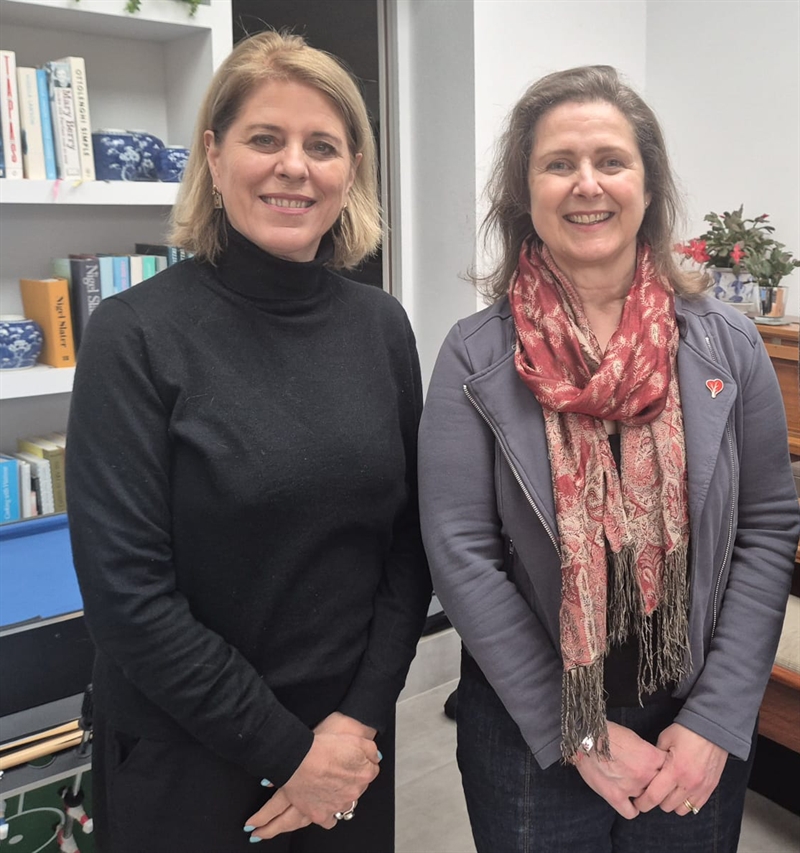
Victoria Macdonald Channel 4 News’ Health and Social Care Editor, recently talked to Heart Research UK, Dr Coral Hanson, Research Fellow Edinburgh Napier University, SCAD expert Dr David Adlam and Beat SCAD Trustee Sarah Coombes (pictured. right. with Victoria) about a research project Heart Research UK is funding to investigate what sort of cardiac rehab and exercise is suitable for SCAD patients.
Traditional cardiac rehab may not be appropriate for SCAD patients and this research follows on from work done by Professor Lis Neubeck, Head of the Centre for Cardiovascular Health at Edinburgh Napier.
Professor Neubeck and her team, including Dr Coral Hanson, worked with 26 patients to co-design a tailored recovery programme for SCAD patients, which involved an eight-week exercise and counselling intervention. She said the high completion rate of the programme indicates that the intervention is highly acceptable to SCAD patients.
Now, Dr Noemi Vadaszy, Research Exercise Physiologist based in Leicester, is working with Principal Investigator Dr Hanson and Dr Adlam on a randomised control trial (RCT) to investigate the feasibility of a 12-week remote exercise programme and to understand the relationship between physical activity and SCAD and its symptoms, including chest pain. This project is funded by Heart Research UK
Dr Hanson commented that all the research that’s been done on cardiac rehab has been done on a different type of heart attack, so we don’t know if that guidance is right for SCAD.
Dr Adlam explained SCAD and added that patients need to understand what’s safe to do and what treatment they could have.
Beat SCAD Trustee Sarah, who had a SCAD 12 years ago, when there was very little support or knowledge about SCAD, told Victoria that we are driven to support patients because we don’t want those who are diagnosed today to go through what patients did when the support wasn’t there.
Victoria also talked to Heart Research UK Research Impact and Communications Officer Elinor Fowler, who explained why the charity is funding this work. She said ‘There is an element that SCAD predominantly affects women and we see systemic exclusion of women across cardiovascular research.’
Heart Research said ‘As awareness of women’s heart health and health equity grows, this research represents an important step towards better diagnosis, improved NHS care pathways, and more lives that can be saved.’